

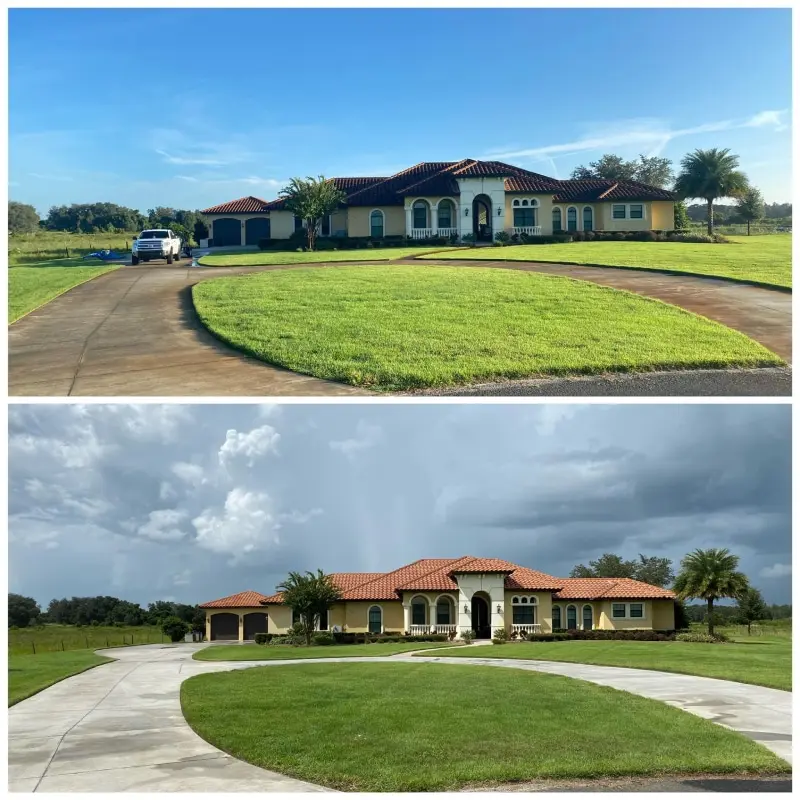
If you live in Central Florida, you have probably watched orange stains creep across your driveway, your paver pool deck, or the concrete around your A/C pad and wondered where they keep coming from. Most of the time, the culprit is iron. Florida groundwater carries it heavily, so every well-fed irrigation system in the metro paints orange arcs onto whatever the sprinklers reach. Iron-rich fertilizer overspray drifts off the lawn onto curbing, and metal patio chairs, grill legs, wheelbarrows, and exposed rebar in aging concrete leave halos that sit through every summer thunderstorm and refuse to budge. A standard pressure wash will brighten the algae around those stains and make the rest of the slab look clean, but the orange stays put once the surface dries. Rust is iron oxide, not organic growth, and the bleach-based mixes most pressure washers use are formulated for algae and mildew.
At Holliday’s Pressure Washing Services, we treat rust as its own job with its own chemistry. We use oxalic acid at the strength the staining actually needs, never maxed out by default, so we can lift the orange while keeping the concrete underneath intact.
If the rust has been bothering you for a season or two, this is the kind of work we run almost every week. Call (407) 276-1343 or request a free quote online, and we will tell you straight what we think we can lift.

Here is what shapes the number on your estimate:
What pushes that rust number up or down on any given quote comes down to four things. The first is the square footage of the rust-affected area, not the whole slab. The second is the surface type, since iron oxide settles into paver joints and takes more work to lift than rust on poured concrete. The third is the severity of the staining, which controls how strong we have to mix the oxalic acid and whether we need a second pass on the deepest spots. The fourth is whether rust is the only thing we are treating or whether it is folded into a broader driveway, paver, or pool deck cleaning.
If you are calling about a rust spot only and nothing else, we will quote that on the call once we know the surface and the size.

Once you fill out the form on the site or call us, Tina returns the call and walks through the scope of the job. We send a written estimate by email, and if there are any honest caveats about staining that may not lift to 100%, those are written into the estimate itself so you can review them before you approve. Once you sign off, we lock the date and send a confirmation. On the morning of your job, you get a text from us on the way with an ETA in minutes.
Two discounts are worth knowing about up front. Combine rust removal with another service at the same property (a house wash, roof cleaning, or gutter cleaning, for example) and we take $75 off the total. If you have neighbors on the same street who want similar work done at the same time, we cut everyone a break. Mention either situation when you call and we will work out the details.


The chemistry stays the same across surfaces: oxalic acid, mixed to the strength the stain calls for. What changes is how we apply it, how aggressively we agitate, and how we rinse and spot-treat afterward.

Standard concrete is our most common rust job in Orlando. Sprinkler iron and fertilizer leave fan-shaped orange arcs across driveways, walkways, and the concrete strip beside the garage. We surface-clean the area first with our 36-inch surface cleaner to lift loose organic growth and debris so the rust underneath shows clearly. Then we mix the oxalic acid on the lower end of its strength and only step it up if a stain refuses to lift. Careful concentration control is the whole reason we can clean rust without acid-etching the slab, which would leave a pale, rough patch worse than the orange we started with.

Pavers are a Central Florida staple, especially around pool decks and lanais. Rust on pavers takes more time than rust on concrete because iron oxide settles into the joints between stones, not just the surface. We work the oxalic acid into the joints rather than only flooding the top, and we rinse carefully to keep the chemistry away from pool water and surrounding landscaping. That extra attention is part of why pavers run a bit higher on our quotes.

Pool decks bring two complications at once. Rust shows up near deck rebar or where metal furniture has been sitting, and there is a pool right there that needs to stay clear of any cleaning chemistry. We rinse away from the pool, never toward it, so the cleaning solution stays on the deck and the pool water stays clear.
A few surfaces are worth a quick phone call before we quote. Hot metal flash-dries oxalic acid before it has time to break down rust, so pieces like patio furniture, railings, or wrought-iron fencing take a different approach than concrete or pavers. Call us about the specific piece and we will tell you whether it fits our workflow and what the work would look like. The same goes for rust on brick, stucco walls, vinyl siding, or pool screen enclosures. Reach out with photos or a quick description, and we will give you a straight, honest read on whether your project is one we can take on.


A lot of pressure washing companies run one bleach-based mix for every surface they touch. We work the other way: each contamination type gets the chemistry built to lift it. That is why our crews show up with the right solution for your job already mixed and ready, instead of trying to bleach rust off a driveway and leaving the orange behind.

The biggest concern with rust removal is acid-etching the concrete or paver underneath, which leaves a whitish, pitted spot worse than the stain you started with. We assess the staining first and mix the oxalic acid only as strong as it needs to be. Our proportioner has adjustable dials, so we step the strength up or down on the fly based on what each surface actually calls for. It is a craftsmanship habit, and it shows in the finished work.

Some rust stains lift completely. Others fade dramatically but leave a faint shadow because iron has soaked deep into porous concrete or paver joints over years. We tell you which result we think is realistic for your surface before we accept the job, and that read is written into the estimate document you sign off on. You see every honest caveat in writing before we ever load the truck.

We run high-output pressure washers (an 8 GPM and a 17 GPM that can be combined for higher flow when a job calls for it). Bigger flow means the job finishes faster, which means less time we are parked outside your house and less time loud equipment is running near your neighbors. The courtesy angle is one of those small things customers tell us they notice.

Tina runs the office side of Holliday’s Pressure Washing. She handles the qualifying call, the estimate, the scheduling confirmation, and the follow-up. A couple of days after the job is done, she calls you on what we call a happy call to make sure the work still looks right in different light. We leave a yard sign at the curb on residential jobs and send an automated review request by text or email. If anything looks off, that follow-up call is your moment to flag it.


Once you submit the form on the site or call us, Tina returns the call and walks through the scope. She asks one simple question on every intake call: is it algae you are trying to get rid of, or is it rust? That single question routes your job into the right chemistry, the right equipment, and the right crew prep before anyone is dispatched.
We email a written estimate that spells out the scope, the price, and any caveats we want you to see in writing about staining that may not lift fully. Nothing on cleanup day comes as a surprise, because everything that matters is on the page you approved.
Once you approve, we lock in the date and send a confirmation. On the morning of the job, you get a text from the crew on the way with an ETA in minutes. You do not need to be home. We can run the entire job and send you photos, an online invoice, and a walkthrough by text.
When we arrive, we make contact if you are home and walk the area together so you can point out the stains that matter most to you. We hook up to your spigot for water on most residential jobs because it gives us the volume we need without draining our tank. If you would rather we bring our own water, we run from our 535-gallon onboard tank or fill up with a fire hydrant meter. On commercial sites, this is when we stage cones and our A-frame signage.
Before any chemistry hits the surface, we walk the perimeter and protect plants near the work area. We ask that pets stay indoors until everything is fully dry. Our crew wears gloves and respirators when working with cleaning chemicals, because that is what working with chemicals professionally looks like.
We surface-clean the area with our 36-inch surface cleaner to lift organic growth and loose grime, then rinse the area down so we can see exactly what the rust looks like underneath. With the stain clearly visible, we mix the oxalic acid at the lowest strength we think will work for your specific surface and severity. We do not default to maximum concentration.
We apply the oxalic acid solution to the rust-stained area and give it time to break down the iron oxide. For stubborn spots that do not lift fully on the first pass, we keep a pump-up sprayer ready with a slightly stronger mix so we can hit individual spots without re-dosing the whole driveway. We rinse the treated area down, walk the surface, and inspect what is left. We repeat the loop on any stains still hanging on until the surface is as clean as the staining will allow.
We take photos of the finished work. If you are not home, those photos go to you by text or email along with the invoice, which you can pay online. We leave a yard sign at the curb on residential jobs, and a couple of days later you will hear from Tina on the happy call to confirm everything still looks right.
We stand behind every job we run. If something is not right, we come back and make it right. That promise applies to every service we offer, including rust removal, which is why the follow-up call from Tina exists at all.
Here is what that promise looks like in practice for rust work: we tell you up front which result we think is realistic for your surface, we write that read into the estimate, and we deliver against the expectation we set. When a stain we expected to fade only fades, you knew that going in. When a stain we expected to leave a shadow lifts completely, we count that as a good day for everyone. Setting honest expectations is how we keep customer trust intact across every job we run.


Pressure washing alone cannot lift rust because rust is iron oxide, not organic buildup. The bleach-based mixes most pressure washers use are formulated for algae, mildew, and dirt. Rust needs a different chemistry, specifically oxalic acid, applied at the right strength for the staining you have.
Oxalic acid is safe for concrete and pavers when it is mixed and applied properly. We assess the staining first and use the acid only as strong as the stain requires, never maxed out by default. The whole point of that dilution discipline is to keep the surface underneath intact.
Rust removal is priced on top of the surrounding cleaning job. The driveway minimum is $200, standard concrete runs about $0.15 per square foot, and pavers cost a little more. When rust is involved, the price roughly doubles, so a $200 driveway with rust comes in around $400 and a $400 paver job with rust runs closer to $800. These are rules of thumb, not fixed figures.
Call us so we can talk through the size, surface, and severity. Most of our rust work is done as part of a broader driveway, paver, or pool deck cleaning, because that is how the staining usually presents. If a stand-alone spot treatment makes sense for your situation, we will tell you on the call.
Some rust lifts completely. Heavier, set-in staining can fade dramatically but leave a faint shadow because the iron has soaked deep into porous concrete or paver joints over years. We tell you which result we think is realistic for your surface up front, and we put that read in writing on the estimate before we accept the job.
The most common sources in Central Florida are iron-heavy well water from sprinkler systems, iron-rich lawn fertilizers, metal patio furniture sitting on pavers, and rebar bleed in aging concrete or pool decks. The Florida aquifer carries a lot of iron, which is why irrigation paints orange arcs onto whatever the sprinklers reach.
Sometimes. Hot metal can flash-dry the chemical before it has time to break down the rust, so metal pieces take a different approach than concrete or pavers. Call us about your specific piece and we will let you know whether it fits our workflow and what the work would look like.
Yes. We rinse away from the pool, not toward it, so cleaning chemistry stays on the deck where it belongs and pool water stays clear. Pool decks are one of our most common rust jobs in Central Florida.
It depends on size, surface, and severity. A typical driveway cleaning runs anywhere from 15 minutes to about an hour and a half with our equipment, and rust treatment adds time on top of that. The exact amount of added time is tied to how stubborn the stain is and how many spots need a second pass.
We can remove what is on the surface today. To keep that result, we recommend addressing the source as well (filtering the well water, replacing a leaky head, or redirecting an arc that is hitting the slab), so the work holds up between cleanings. We are happy to point out what we see on the walkaround.
If those orange stains have been sitting on your driveway, lanai, or pool deck for a season or two, this is the right time to deal with them while the staining is still on the surface. Call (407) 276-1343 or request a free quote online, and we will tell you straight what we think we can lift and put it in writing before you commit to a date.


