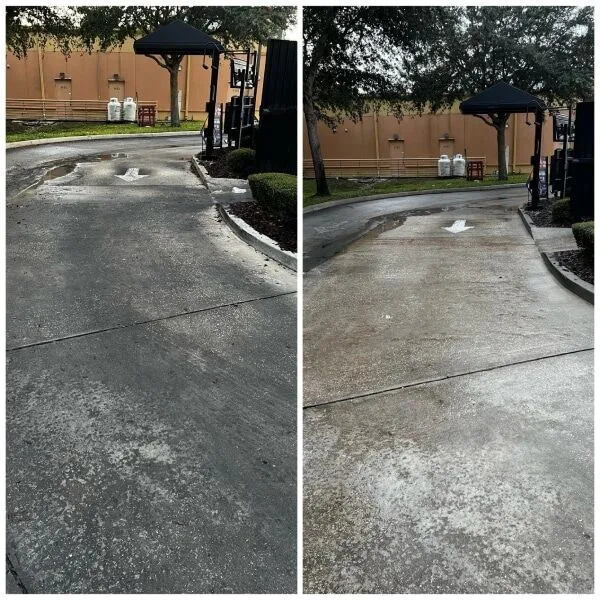


Drive-thru lanes in Orlando take more abuse than any other flatwork on a QSR property. Cars idle for minutes at the order point along Sand Lake Road, International Drive, OBT, and the 408 corridor, dripping oil onto the same patch of concrete dozens of times a day while tire rubber and brake dust grind into the surface. Bag grease, gum, drink spills, and food residue pile up at the pickup window. Afternoon thunderstorms spread oil sheen across the lane, and Central Florida humidity feeds algae growth on shaded sections of the pad inside of a few weeks.
Holliday’s Pressure Washing Services built its commercial protocol around that exact problem. We run overnight, bring our own water, and use a hot water rig at roughly 250°F paired with a commercial-grade degreaser to lift baked-on oil, gum, and grease at the order point and pickup window. Daniel personally schedules and runs commercial overnight crews, so the person making the promise is the same person on the property at 1:30 in the morning.
If your lane is due for a refresh or you want a recurring partner who shows up on schedule, call us at (407) 276-1343 and we will scope your property. Recurring contract pricing is available for monthly, quarterly, and biannual cadences.

Every drive-thru is priced individually. The lanes we clean range from a tight in-and-out at a coffee shop to a wraparound double-lane at a national QSR with a separate pickup pad, and the contamination profile changes with each one. We build the estimate from a square-foot base (the standard pricing model for all of our flatwork) and adjust from there based on what your site actually needs.
Pricing for drive-thru cleaning is available upon request. The factors that move the number up or down include:

Reach out through our contact form or call our office. Tina answers our office line by default and walks you through the qualifying questions: lane dimensions, surface material, contaminant type, drive-thru operating hours, after-hours access logistics, drain locations, and whether the property has a grease trap or oil-water separator. Once we have the basics, we either run a short site visit or finish scoping on the phone, then send a written estimate by email for your review.
If you are running multiple locations and want a single number for a recurring program, we can quote the cadence (monthly, quarterly, or biannual) and build the contract pricing around the schedule. Our auto-reminder system fires ahead of every scheduled cleaning, so a quarterly client does not have to remember to call us.


A standard concrete lane is what we built our flatwork rig around. We run a 36-inch surface cleaner at a combined 25 GPM (a 17 GPM machine and an 8 GPM machine Siamesed together) for a fast, even, single-pass clean on the lane body. Hot water at roughly 250°F is engaged for the order point and pickup zones where degreaser is dwelling. A light sodium hypochlorite post-treatment handles any remaining algae or organic staining on shaded sections.
Paver lanes require more care than poured concrete. We use controlled pressure so the joint sand stays where it belongs, and we post-treat for any organic growth between the pavers. Pavers cost a little more to clean than smooth concrete for that reason, and we factor that into the quote up front rather than after the work.
The order point pad and the pickup window pad pick up the heaviest contamination on any drive-thru property. Idling vehicles at the order point drip oil throughout each order, while bag grease, dropped gum, drink spills, and food residue land at the pickup window. Our sequence is straightforward: we walk the lane and flag both zones, pre-treat with a commercial-grade degreaser, agitate with a stiff brush, allow roughly 20 minutes of dwell time so the degreaser breaks the bond between grease and the concrete pores, then surface clean the zone with hot water at around 250°F. Deep, long-standing oil stains sometimes leave a residual dark shade after cleaning, and we set the expectation for that on the estimate before any work starts.
Curbs catch overspray from landscape sprinklers, fertilizer migration, and dumpster bleed. We use a wheeled curb tool called a Curbinator that cleans the flat top, vertical face, and base of a curb in a single pass. Originally built into the rig for big HOA jobs, it works the same way along a drive-thru curb run. Curb cleaning is offered as an add-on to lane cleaning when your curbs need attention.
Soft wash only. We apply a low-pressure chemical wash, let it dwell, and rinse it clean. That clears bag grease and hand prints off the cashier exchange window frame, lifts road grime and bird droppings off the menu board face, and pulls grease film off the order kiosk. Painted logos, vinyl wraps, and any branded housings stay protected by the soft-wash approach.


After-hours scheduling is our default for every commercial job we run, not a special favor. On a Starbucks job along the corridor, Daniel had the rig staged and the lane finished well before the 5 AM open, and staff arrived to a clean, dry pad and a workable drive-thru. Overnight is the standard because daytime work creates real liability for the operator and disrupts the shift, and our crews are built for the night cadence.

Grease, gum, and baked-on automotive oil need real heat to come off cleanly, which is why we run a hot water unit at roughly 250°F. For context, boiling water is 212°F. The temperature pulls grease off the surface so the lane reads clean by morning rather than smeared and grey.

Daniel’s equipment philosophy is simple: buy the biggest, highest gallon-per-minute machines so the crew finishes faster, the site quiets down sooner, and the overnight window stays short. The 36-inch surface cleaner moves through lane footage fast, and the 17 GPM and 8 GPM machines Siamese to 25 GPM combined flow. A typical drive-thru lane sits inside a one-to-three hour active-work window, which matters when you have apartments above the lot, a 24-hour neighbor business, or a hotel next door.

We bring our own water to every commercial job. A 535-gallon tank rides on the trailer and we carry fire hydrant meters for legal refills nearby, so we arrive ready to clean. Your hose bibs stay untouched and your water bill stays out of the equation.

Our cleaning sequence is built around the storm drains that ring most QSR lots. We surface clean the lane with water only first, so the only thing entering any drain at that stage is rinse water. Then we apply a light sodium hypochlorite post-treatment and let it dry on the surface rather than flushing it into the system. When the runoff path is sensitive, such as close to waterways or in stricter jurisdictions, we substitute an eco-friendly cleaner in place of the sodium hypochlorite.

Every estimate we send for a drive-thru lays out scope, timing, and any expected limits on outcomes before you approve the work. Deep oil stains, in particular, get an honest assessment at quote time so what we deliver matches what you were quoted. The same clarity carries through scheduling, on-site updates, and the final invoice.
The crew stays on site until the lane reads spot-free under flashlight, and anything that needs another pass gets re-hit before we pack up. If a spot turns up under daylight a day later, we come back and touch it up at no charge.
A couple of days after the job, Tina calls the property contact to confirm everything looks right under daylight. Anything that needs follow-up gets scheduled for a return visit. An automated review request goes out by text or email in parallel, and Tina reinforces the prompt verbally on the happy call.
We start chemical strength low and dial up only as far as the surface needs, using a proportioner on the rig. The approach protects painted lane stripes, stamped pad logos, vinyl wraps on menu boards, and painted curb markings. Lane stripes stay sharp, stamped logos stay defined, and the lane comes out clean.
We stage A-frame caution signage at both ends of the active lane (one at the entry, one at the exit) and use high-visibility cones to define the wet zone and protect hose runs. On shared lots where a 24-hour neighbor business shares pedestrian traffic with the QSR, we station a crew member at the lot edge with an umbrella to walk anyone through the work zone dry. That part is built into our setup for apartment complex breezeways, and it works the same way around a QSR lot.
We stage A-frame caution signage at both ends of the active lane (one at the entry, one at the exit) and use high-visibility cones to define the wet zone and protect hose runs. On shared lots where a 24-hour neighbor business shares pedestrian traffic with the QSR, we station a crew member at the lot edge with an umbrella to walk anyone through the work zone dry. That part is built into our setup for apartment complex breezeways, and it works the same way around a QSR lot.

The first contact comes in through our web form or our office line. Tina handles intake and walks through the qualifying questions: lane dimensions, surface material (concrete, pavers, or asphalt), contaminant type (oil, gum, grease, algae, rust), drive-thru operating hours, after-hours access logistics (gate codes, night manager contact), drain locations on the property, and whether the lot has a grease trap or oil-water separator. A thorough intake keeps the night of the job on schedule.
For larger or more complex sites, we run a short on-site walk. For straightforward lanes, we finish scoping on the phone using lane measurements and photos. Either way, you get a written estimate by email built from a square-foot base, with add-ons itemized so the line items match the work.
Once the estimate is approved, we lock in an overnight window outside your drive-thru operating hours and confirm the date with your point of contact. On the night of the job, you receive a text when the crew is on the way along with a minutes-out update, so you always know when we are arriving.
The truck and trailer park clear of the drive-thru entry and exit so the lane stays workable. We stage the 535-gallon water tank near the lane, or pre-arrange a fire hydrant fill nearby. A-frame caution signage goes up at both ends of the work zone, and high-visibility cones define the wet zone and protect hose runs. If a 24-hour neighbor business shares the lot, a crew member is assigned at the lot edge with the umbrella escort.
We walk the lane and flag the order-point pad and the pickup window pad as the heavy-contamination zones. Both zones get pre-treated with our commercial-grade degreaser, agitated with a stiff brush, and given roughly 20 minutes of dwell time. The lane body itself does not usually need pre-treatment.
We hook up to water and run the 36-inch surface cleaner at 25 GPM combined flow on the lane body. We run hot water at roughly 250°F over the degreaser-treated zones to cut the grease as it lifts. Any remaining stubborn spots get treated with a pump-up sprayer carrying a stronger mix. We rinse the entire lane cleanly, then post-treat with a light sodium hypochlorite application for any remaining algae or organic staining. Rust spots are addressed with oxalic acid at the minimum effective strength.
When the scope includes the menu board, order kiosk, drive-thru window frame, or curbs, we run those add-ons after the lane body is clean. Once the work is wrapped, the crew runs the flashlight walk-through and re-hits anything before sign-off.
We send before-and-after photos to your property contact. Equipment is broken down, signage and cones collected, and the lane reopened in time for the morning shift. The invoice goes out the next day for online payment, and the office runs a follow-up call a few days later. For recurring contract clients, the auto-reminder system fires ahead of the next scheduled cleaning, keeping the cadence on track.
Our commercial work is backed by a spot-free guarantee, a satisfaction commitment that brings us back on site if something needs another pass, and a straightforward estimate that lays out realistic outcomes before any work begins. When something traces back to us, we put it right. Our process for the heaviest commercial buildup (degreaser, stiff brush, 20-minute dwell, and 250°F hot water rinse) is built specifically for the order point and pickup window, and the estimate makes the expected outcome clear from the start.
What is not covered:


Yes. Overnight scheduling is the default for every commercial job we run. A recent Starbucks lane we cleaned started at 1:30 AM and was finished before the 5 AM open. We stage, clean, dry, and reopen the lane before staff arrive for the morning shift.
A typical lane cleaning runs one to three hours of active work, plus setup and breakdown. Total lane closure is usually two to four hours, scheduled inside your closed window so your morning rush opens on schedule.
No. We fully rinse the lane at the end of the cleaning and walk it under flashlight before sign-off to confirm no chemical residue is left on the surface. Once dry, the lane has the same footing it had before cleaning. Removing baked-on grease and gum improves traction for staff and drive-up customers.
No. We dial chemical strength up from the lowest setting using a proportioner on the rig, only as strong as the surface requires. Painted concrete, stamped logos, vinyl wraps on menu boards, and painted lane stripes stay protected by that approach. Pressure stays low enough that paint and stamped finishes hold up cleanly through the wash.
We surface-clean the lane with water only first, so only water enters any storm drain at that stage. Our sodium hypochlorite post-treatment is applied lightly after the rinse water has cleared, and it is left to dry on the surface rather than flushed into the drain. The procedure is built specifically for storm-drain-adjacent flatwork.
No. We bring a 535-gallon water tank on the trailer and carry fire hydrant meters for legal refills nearby. Your property’s water access stays untouched.
Most stains lift cleanly. Old, deep-soaked oil stains can leave a residual dark shade after cleaning, even with the most thorough process. We commit to the strongest commercial-grade degreaser process available, which is degreaser plus stiff brush plus roughly 20 minutes of dwell time plus a 250°F hot water rinse, and we set realistic expectations on the estimate so you know what to expect.
No. Gas station pads carry a fuel-runoff profile that calls for a water reclamation rig we do not run. A QSR drive-thru is a different use case (idling-car oil drips and food residue, not gasoline) and is firmly inside what we do.
It depends on traffic volume and shade exposure on the lane. High-volume Orlando QSRs typically benefit from monthly cleaning to keep oil from setting. Mid-volume locations run quarterly. Lower-volume or seasonal operators run biannually paired with a deeper clean before peak tourism season. Central Florida humidity speeds up algae growth on shaded pad sections, so cleaning cycles run more frequently here than they would in a drier climate.
Yes. Those are soft wash add-ons to the lane cleaning, handled at low pressure with a chemical wash and a clean rinse. The menu board face, order kiosk, drive-thru window frame, and pickup-pad detail are all scoped as add-ons when included.
Drive-thru lanes in Florida’s climate do not stay clean on a single service. Grease, organic growth, and automotive residue return on a predictable cycle tied to traffic volume and season, and letting that cycle run unchecked means each cleaning takes longer and costs more than consistent maintenance would.
For properties where clean lanes are a baseline operating requirement, we offer recurring service agreements on monthly, bimonthly, or quarterly schedules, with pricing that reflects the ongoing relationship. If you manage multiple commercial locations across Central Florida and want them on a coordinated plan, reach out and we can build a schedule that covers your full portfolio without gaps between services.
Looking for an overnight crew you can trust to leave your lane spot-free by morning? Our crew, hot water rig, and spot-free walk-through are built so your team walks in to a clean, dry, workable drive-thru ready for the morning rush.
Call us at (407) 276-1343 or send your details through our contact form to get a custom quote for your Orlando property.