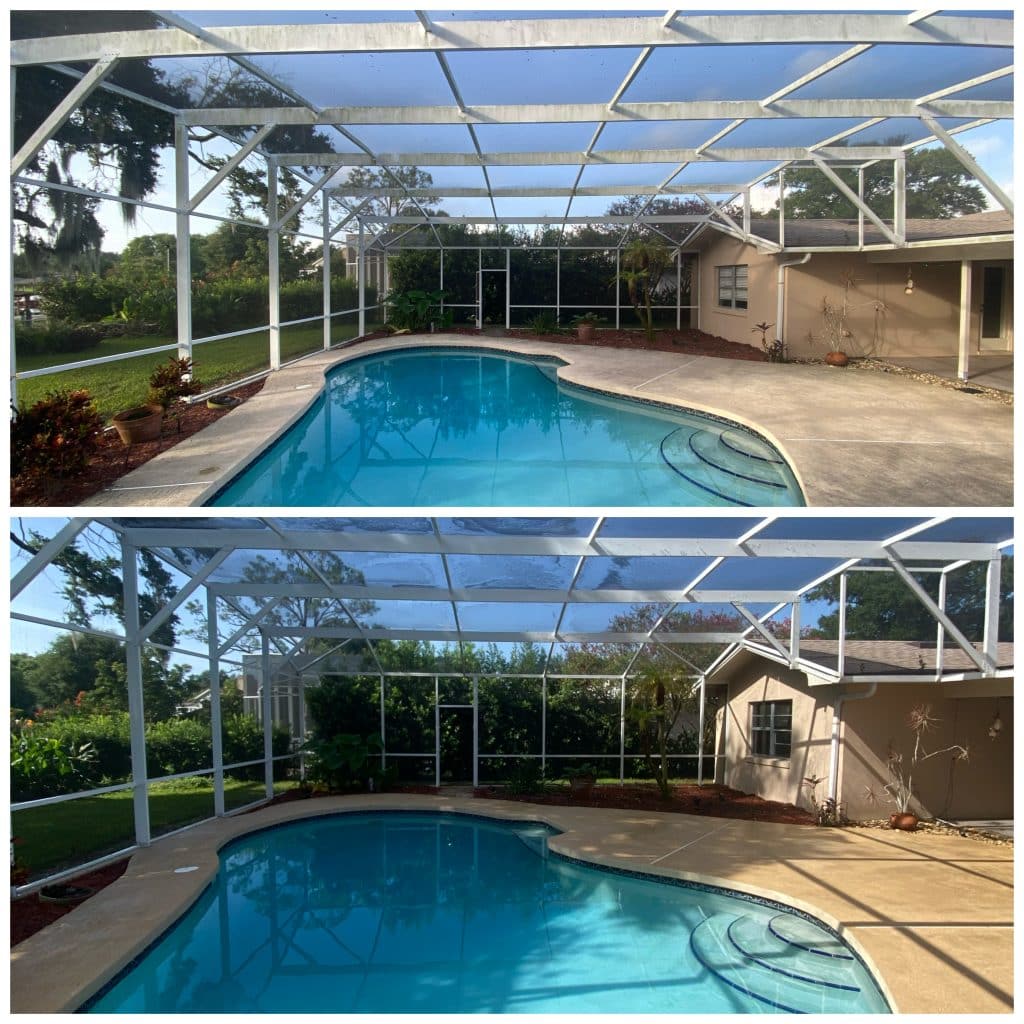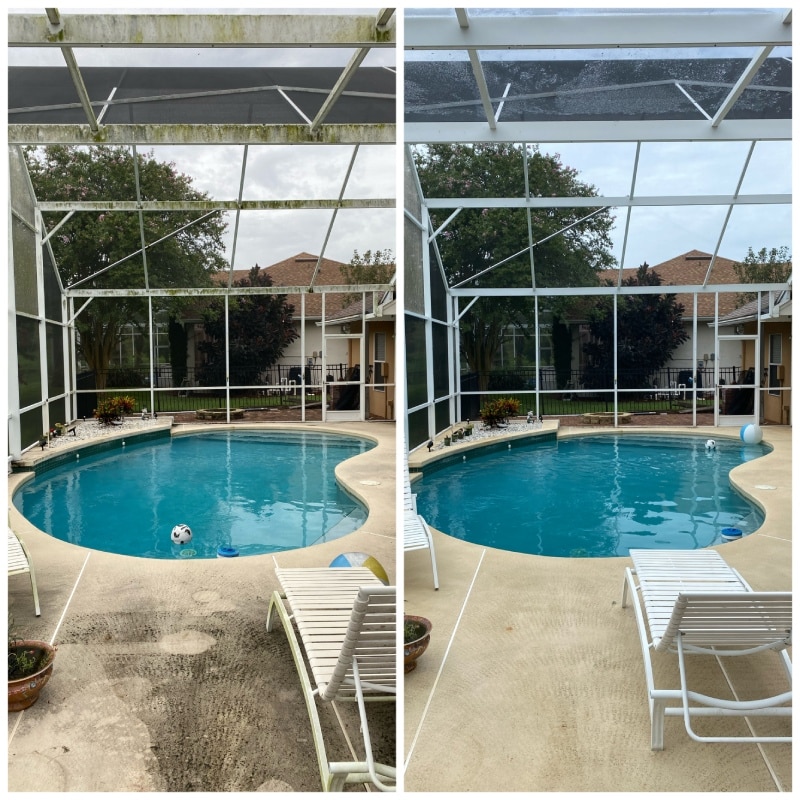


Walk through almost any neighborhood in Orlando and screened pool enclosures are everywhere. Some wrap around modest single-story backyards. Some climb two stories behind larger custom homes. They’re the reason you can enjoy your pool in July without sharing it with mosquitoes. They’re also the reason most Orlando homeowners end up with a slow, low-grade problem on their hands. Central Florida’s growing season runs long, afternoon storms dump rain across screens that never fully dry between bursts, and oak pollen settles into every panel. Within a couple of seasons, the cage starts to look dim from inside, dark streaks run down the panels, moss takes root in the mesh, and the pool deck goes slick with algae after every rain.
Holliday’s Pressure Washing Services treats pool screen cleaning as its own specialty, not a tack-on to a house wash. Every screen, every frame beam, every kickplate gets cleaned with 100% soft wash, never high pressure. The pool deck inside the enclosure is included in the same job, not billed as an extra. The entire crew works around a deliberate rinse-away-from-the-pool pattern, so the dirty water that comes off your screens stays out of your swim area.
Call us at (407) 276-1343 to talk through your enclosure, or send your details through the contact form on our website. We run the intake, ask what you’re actually seeing in the cage, and get a written estimate over to you before anything is scheduled.

Pool screens are quoted custom per job. A pool cage has three surfaces to deal with all at once (the walls of the enclosure, the roof of the cage, and the deck inside), and conditions vary too much from one yard to the next for a flat-rate or per-square-foot formula to fit. For a typical single-story pool screen enclosure, our pool screen cleaning starts at $300. Two-story enclosures, which are common behind larger custom homes around the Orlando metro, run roughly double, around $600.
There are four real variables that move the price up from there. You’ll see every one of them spelled out before any work gets scheduled:
You see all of it in writing first, with each variable explained line by line so the estimate matches what we’ll find on-site.

We run one discount across the whole business, and it’s worth knowing about if you’re already thinking about getting more than one thing cleaned this season. Bundle pool screen cleaning with any other service we offer and we take $75 off the total. Just two services is all it takes to qualify.
Because the pool deck inside the enclosure is already part of the pool screen price, the bundle kicks in when you pair pool screen cleaning with a second, separate service. Eligible pairings include:
Most of our Orlando customers stack two or three of these in the same booking and pick up the $75 off on the total.


Pool screen cleaning covers the whole enclosure system, not only the screens. Here’s exactly what gets treated and how.

The screen mesh gets a full soft-wash treatment. We use a sodium hypochlorite-based cleaning solution mixed with soaps, diluted through an adjustable proportioner that lets us start at the lowest effective strength and only dial up to what the buildup actually needs. The solution is sprayed at an angle so it clings to the vertical mesh long enough to break down algae, mold, mildew, and any moss that’s worked its way into the panels. After it dwells, we rinse it through gently. The mesh is cleaned exclusively with soft-wash chemistry and a gentle rinse, with all high-pressure equipment kept on the truck.

The same soft-wash chemistry runs across the aluminum frame, kickplates, and structural beams holding your cage together. Beams have multiple faces, so our crew treats every face on every beam from both directions, making sure each surface gets coverage front and back.

For paver decks inside the enclosure, the technique shifts because pavers respond better to mechanical cleaning than chemistry alone. We use pressure washing with a surface cleaner, which is a rotating round attachment that runs even passes over flat hardscape, and sometimes a turbo nozzle to lift stubborn buildup from the joints and surface. All rinse direction is pointed away from the pool.

Painted concrete decks are common around Orlando, and they’re the surface homeowners worry about most. Instead of pressure washing them like pavers, we apply a slightly stronger cleaning solution to break down the algae bonded to the painted finish, let it dwell, then finish with what we call controlled pressure. Controlled pressure means the force is measured against the surface, just enough to lift the broken-down algae while leaving the paint completely intact. Decks cleaned this way come back refreshed with the painted finish still pristine.

The pool itself is treated as a no-contamination zone. All cleaning solution and rinse water are directed away from the swim area at every step of the job, and your pool chemistry stays exactly the way you left it.


The number-one question homeowners ask before booking is whether high pressure will damage their screens. Our answer is built into the process itself: every screen and frame gets soft-washed start to finish, every job. Cleaning solution and a gentle rinse do the work. The panels stay intact, the seams stay tight, and the mesh keeps its shape and tension long after we leave.

When we quote pool screen cleaning, the deck inside the enclosure is part of the job, built into the quote rather than charged as an extra. The deck material affects the price because pavers and painted concrete take different techniques and different equipment, but the deck cleaning itself is always part of what you’re booking. Most of our Orlando customers don’t realize that until they see the quote and notice how much is bundled in.

Our crew runs the same sequence on every cage. Cleaning solution goes on the deck inside the enclosure first so it can dwell while the screens are getting treated. We work the outside of the cage, rinse it clean, then move inside. Once we’re inside, we sweep the screens and beams in two directions, clean the deck according to its material, and rinse with the water direction always pointed away from the pool. The final step is pushing leftover water out the enclosure door so it stays clear of the swim area. Every drop of water has a planned path before the cleaning solution ever leaves the rig.

Pool cage panels and beams have multiple faces, and each one deserves attention. Our crew works every panel and every beam twice, once facing one direction and once facing the other. Both sides of every screen panel get touched. Every face of every beam, front and back, gets the solution and the rinse. The two-pass approach takes a bit longer than a single sweep, and it’s the reason our cages look uniformly clean from any angle when we’re finished.

Once you’re scheduled, the communication keeps you in the loop from start to finish. You see a confirmed date in writing. On the day of the appointment, you get an “on the way” text with an ETA in minutes. When the crew arrives, they walk the enclosure with you if you’re home. When the job is done, photos go to your phone, a digital invoice follows, and a few days later we make a happy call to check that everything still looks right after you’ve had time to walk around the cage.
Daniel made a deliberate choice years ago to invest in the highest-gallon-per-minute machines available. The practical benefit shows up on your property: jobs finish faster, the work stays quieter, and the crew keeps a clean footprint on your yard. The setup includes a 535-gallon onboard water tank, so we can come fully self-contained or hook up to your spigot, depending on what works for your job.
Limits are part of the trust. We focus exclusively on cleaning, which means repair, replacement, and re-screening go to the installers who specialize in that work. If we arrive and find an enclosure that’s structurally compromised, we’ll point out what we see and recommend getting the repair done first, since cleaning can’t substitute for structural work. And we stay committed to the soft-wash, two-direction approach on every job, even when skipping a step would be faster. If your cage needs repair before it needs cleaning, you’ll hear that from us up front.

Once you reach out, either through the contact form on our website or by phone, we will follow up to gather the details that drive your quote. She’ll ask what you’re seeing on the cage (algae, moss, mildew streaks, deck staining), whether you have a single-story or two-story enclosure, and what the deck inside the enclosure is made of. If you have unusual conditions like a torn panel you already know about, this is the moment to flag them so the estimate matches what we’ll actually find on-site.
A custom estimate gets built from the conditions we collected, and you receive it in writing for your review. You can request adjustments before approving anything, so nothing about scope or price is decided without your sign-off. Once you approve, the job is added to our schedule and you’ll see a confirmed date with a real time window.
The morning of your appointment, you’ll get an “on the way” text with an ETA in minutes. When the crew arrives, they meet you, walk the enclosure with you if you’re around, and confirm the scope before any equipment comes off the trailer. This is also the moment to point out any pre-existing damage, like a panel that was already loose, so everyone’s on the same page about the cage’s starting condition. You don’t need to be home for the job; if your schedule doesn’t allow it, we’ll handle communication remotely and send photos when the work is finished.
The crew starts on the exterior of the enclosure. Cleaning solution gets applied at an angle so it clings to the vertical mesh long enough to actually break down what’s growing on the screens. The whole outside of the cage gets treated. Plants and landscaping around the enclosure are protected before any chemistry comes out. Once the solution has done its work, the entire exterior gets a full rinse with fresh water at gentle pressure only.
The crew moves inside the enclosure and starts by applying cleaning solution to the deck. This is deliberate timing. The solution dwells on the deck while the screen work is happening, which means the algae bonded to your deck gets a head start on breaking down instead of waiting for a separate pass at the end. By the time we come back to finish the deck, it’s already half done.
The crew starts at one end of the enclosure and works systematically toward the other, treating every screen panel and every beam from one direction. They then turn back and treat the same surfaces from the opposite direction, so both faces of every panel and every side of every beam get the solution and the rinse. By the end of this step, the entire interior is uniformly clean from any angle.
With the screens done, the crew finishes the deck. Pavers get a surface cleaner with a turbo nozzle on stubborn spots. Painted concrete gets controlled pressure that keeps the paint intact. The full enclosure gets a final rinse, and then the crew physically pushes any remaining water out the enclosure door, keeping it clear of the swim area.
Before the crew leaves, the work gets checked on-site. Photos go to your phone showing the completed job, and a digital invoice follows with online payment options. A few days later, we will make what we call a happy call to check that the cage still looks right after you’ve had time to walk around it and see the screens in different light. If anything needs attention, we schedule a return visit. You’ll also get an automated text or email with a review link, and we will mention it on the happy call if you have a moment to leave one.
We stand behind every pool screen cleaning job with our company-wide satisfaction guarantee. If something needs another look when we leave, or if something surfaces in the days after the job, we come back and make it right. That’s exactly why we make the happy call a few days later. The return visit is part of the job, with no extra paperwork, no scope debate, and no additional charge.
The way issues actually get resolved is straightforward. You raise a concern, often during the happy call a few days later. We get a return visit on the schedule at a time that works for you. The crew comes back and handles whatever surfaced. That’s it.
We’re also straightforward about what our guarantee covers. It backs the work we perform on the day, which means the cleaning quality, the rinse coverage, and the condition of the enclosure when we leave. For long-term protection, we recommend yearly cleaning rather than a long-term warranty, because Orlando’s growing season is too active to promise spotless results six or twelve months out. A cage that’s spotless in March can pick up oak pollen and mildew streaks by July, which is exactly why annual service makes sense.


No. Our pool screen cleaning process is soft wash from start to finish. Cleaning solution and a gentle rinse handle the buildup on the mesh and frame, so the panels stay intact and the seams stay tight.
Pool screen cleaning starts at $300 for a single-story enclosure. Two-story enclosures run roughly double, around $600. The final price depends on the size of your enclosure, whether it’s single or two-story, your deck material, and how much buildup is already on the screens and deck.
Yes. The deck inside the enclosure is included in the pool screen cleaning service, not charged as a separate item. The deck material affects the price because pavers and painted concrete take different techniques, but the deck cleaning itself is always part of the job.
No. Our workflow directs every drop of cleaning solution and rinse water away from the pool. Solution is applied to the ground inside the enclosure first to dwell. Rinse water runs away from the pool, and any leftover water gets pushed out the enclosure door at the end of the job.
We recommend yearly. Central Florida’s growing season is long, pollen-heavy, and humid, so screens collect organic buildup fast. Annual cleaning keeps moss from embedding in the mesh and turning into a bigger, more expensive job down the road.
No, not when it’s cleaned the right way. Painted concrete decks get a soft-wash treatment with a slightly stronger cleaning solution to break down the algae, followed by controlled pressure that won’t lift, peel, or chip the paint. We adjust the technique to the surface, not the other way around.
Yes, that’s part of what we clean. Moss in the mesh comes off with the same soft-wash chemistry we use on algae and mildew. If a screen has a lot of visible moss, expect the job to land toward the higher end of the price range because the buildup takes more cleaning solution and more careful rinsing.
No. We focus on cleaning, so repair, re-screening, and panel replacement go to the specialists who handle that work. If we arrive and find structural damage to your enclosure, we’ll show you what we see and recommend getting the repair done first.
Yes. Bundle pool screen cleaning with any other service we offer and we’ll take $75 off the total. Two services is enough to qualify; you don’t need three. Popular pairings include pool screen cleaning with roof cleaning, house washing, or driveway and concrete cleaning.
A cage with torn panels separating from the frame or rusted-out structural members needs repair before cleaning. We’ll come look, show you exactly what we see, and recommend the right next step before any cleaning gets scheduled.
Ready to see your pool cage clean from the inside out? Call us at (407) 276-1343 or send your enclosure details through the contact form on our website to get started. Every quote comes in writing with each variable spelled out, so you know exactly what’s included before anything lands on the schedule.