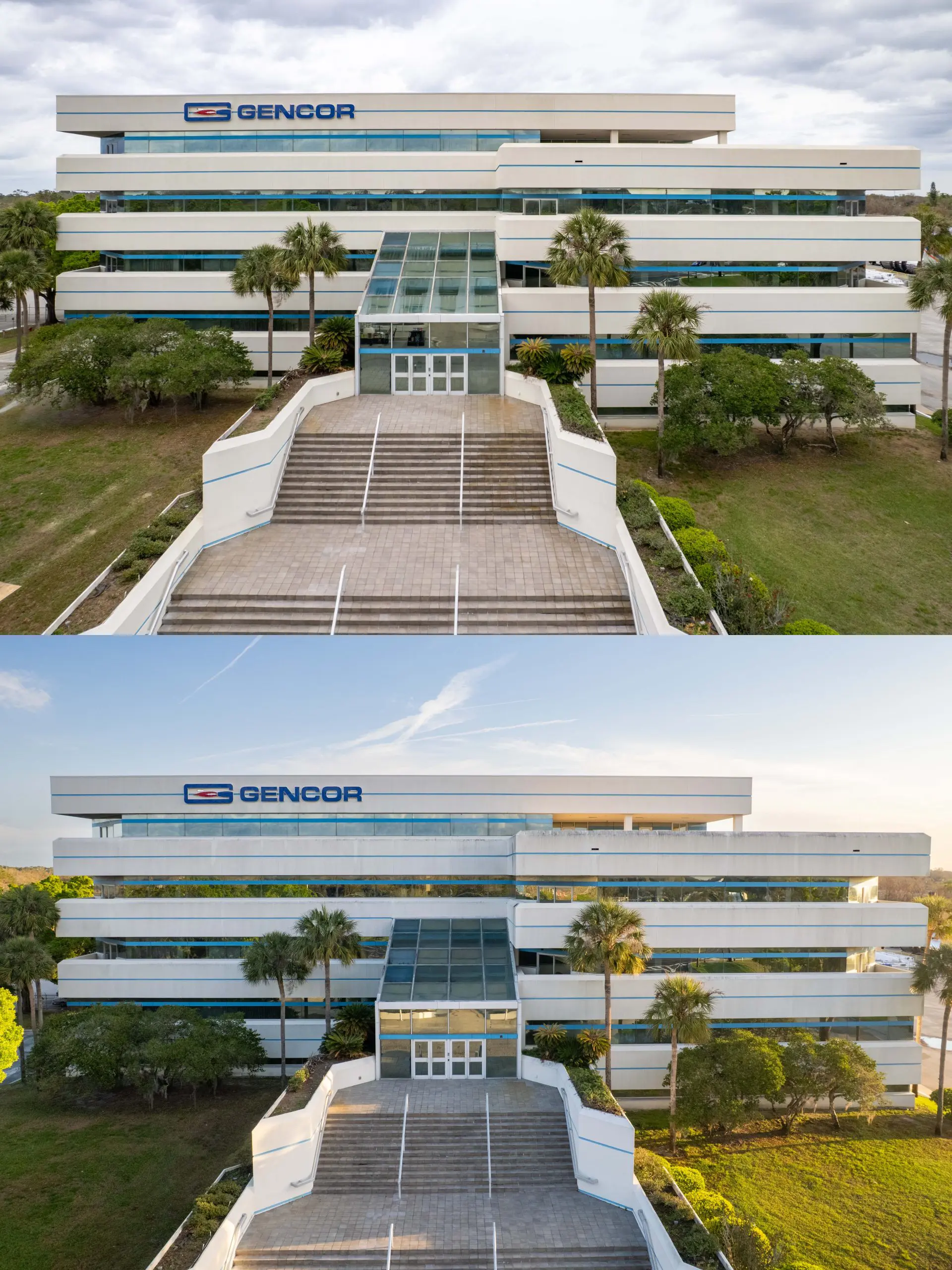


Orlando’s wet season runs from June through October, and those five months of afternoon thunderstorms, standing moisture, and near-constant humidity are enough to coat any commercial building exterior in algae, mold, mildew, and environmental grime. Stucco facades on apartment complexes turn green. Vinyl-clad retail storefronts collect dark streaks along rooflines. HOA common areas near retention ponds and lakes pick up growth faster than the rest of the property. For a property manager responsible for tenant satisfaction, curb appeal, and long-term asset value, that buildup is more than a visual problem. It’s a liability and maintenance issue that compounds the longer it sits.
Holliday’s Pressure Washing Services handles commercial building washing across the Orlando metro for apartment complexes, HOA communities, retail storefronts, and restaurant exteriors. We use the same proven soft wash chemistry and section-by-section process that works on residential properties, scaled up with higher-GPM equipment, after-hours scheduling, and traffic-control protocols. Every commercial job includes tenant-safety measures like ground spotters, breezeway umbrellas, and dual-end signage at every active work zone. Daniel Holliday is selective about the commercial work he takes on, and that selectivity is the reason property managers keep calling back.
If you manage a commercial property in Orlando that’s due for exterior cleaning, call (407) 276-1343 or submit a request through our website. We’ll put together a detailed estimate built around your building’s size, surface materials, scheduling needs, and access requirements.

Every commercial building wash is quoted on a per-property basis. There is no flat-rate menu. We build each estimate around the specific conditions of the property, because a simple one-story retail building with easy water access is a fundamentally different job than a three-story apartment complex with breezeways, after-hours scheduling, and waterway-adjacent runoff restrictions.
The factors that drive your price include:
Each factor ties to a real cost in our operation: labor hours, equipment deployment, chemistry, or risk management. A straightforward rectangular building with ground-level access will sit at the low end. A multi-story, irregularly shaped property requiring combined machines, overnight scheduling, and environmental controls will sit at the high end.

For property managers and HOA boards who budget for ongoing maintenance, recurring commercial contracts earn a negotiated price break. A common cadence for apartment complexes in Orlando is twice per year, and the discount is built into the contract value based on scope, frequency, and property size.
Locking in a recurring schedule gives you two things beyond the cost savings: predictable annual budgeting and priority scheduling during Orlando’s busy wet season, when demand for commercial exterior cleaning peaks. If your property accumulates organic buildup quickly, a standing contract means you’re never scrambling to find a contractor when the building starts looking rough.


Stucco is one of the most common commercial building materials in Central Florida, and it’s a magnet for algae and mildew in Orlando’s climate. We apply sodium hypochlorite mixed with professional-grade soaps, diluted to the proper strength using adjustable proportioner dials. The entire process is soft wash only, with zero high pressure applied to building walls. Each section is treated individually so the cleaning solution never has time to dry on the surface, and every section gets a second check before we move on.
Same soft wash chemistry as stucco, with strength starting low and adjusted upward only to what the buildup demands. Our proportioner system lets us fine-tune concentration in real time rather than committing to a single mix for the entire building. That precision matters on commercial buildings where different sections may have different levels of contamination.
Hardy board is showing up on newer commercial construction across the Orlando metro. We treat it with the same SH-based soft wash approach, applied section by section, with chemistry dialed to the minimum effective strength. No high pressure. The factory finish stays intact.
For organic buildup on brick, we use the standard soft wash process. For rust staining on brick or masonry substrates, we apply oxalic acid and dial it up only to the strength the stain requires. This prevents acid-etching on the surface while still pulling the stain. If your building has both organic growth and rust, we treat them with separate chemistry in the same visit. We also offer standalone rust removal for isolated staining on any commercial surface.
Metal requires specific precautions. We dilute the chemistry more than we would on other surfaces, keep the metal constantly wet to prevent flash-drying, and cool the surface down before applying any solution if it’s been sitting in direct sun. Metal that flash-dries mid-application can oxidize or suffer chemical burns, and we’d rather take the extra time than risk damaging a panel. If your building has metal siding or panels, mention it when you call so we can plan the right approach from the start.


Daniel recently completed a Starbucks exterior wash and arrived at 1:30 a.m. to finish before the 5:00 a.m. open. For businesses with steady customer foot traffic, overnight service is the default, not a special request. We would rather turn down a daytime commercial job at a busy location than put your customers in the path of overspray, wet walkways, or hose hazards. This is a non-negotiable part of how Holliday’s Pressure Washing operates on commercial properties.

We don’t take every job. Gas stations are off the table entirely because fuel-contaminated runoff can’t legally go down storm drains, and we don’t operate water-reclamation equipment. Most gas station operators aren’t willing to pay the premium that responsible handling requires, so we remove the category rather than cut corners. The same discipline applies to SH application near waterways and daytime scheduling at high-traffic locations. If we can’t do it right, we’d rather tell you upfront.

We set up cones and A-frame signage at both ends of every active work zone, with messaging about pressure washing, hose hazards, and overspray. At apartment complexes, we position a ground spotter to manage foot traffic and keep tenants out of active wash areas. For breezeways where tenants need to pass through during work, a crew member walks them through under an umbrella so they don’t get hit with cleaning solution or water. That umbrella detail might sound small, but it’s the difference between a tenant walking to work in soaked clothes and one who barely notices we’re there.

Our equipment lineup is designed for large-scale commercial work, not residential rigs stretched beyond their capacity. We run the highest-GPM machines available, including a 17-GPM unit and an 8-GPM machine that can be combined (Siamesed) to produce even higher flow on big jobs. The 36-inch surface cleaner handles sidewalks and parking lot surfaces efficiently, and the Curbinator gives us single-pass curb coverage that most competitors handle with a wand. We also carry a hot water unit that reaches approximately 250°F for oil, gum, and grease. Daniel’s investment philosophy is simple: bigger, faster equipment means less time on your property, less noise disruption, and a better result.

Most commercial jobs require us to bring our own water. We carry a 535-gallon onboard tank and fire-hydrant meters for refilling on longer jobs. Your property doesn’t need accessible spigots, and we don’t depend on building water infrastructure that may not produce enough flow for commercial-scale cleaning. This removes a common scheduling obstacle for property managers.

We follow two active environmental protocols on commercial jobs. First, we do not apply sodium hypochlorite over or near waterways. Instead, we use an eco-friendly cleaning solution that won’t harm aquatic life. Second, for community common areas, we surface clean first with plain water so only water enters the storm drain, then lightly post-treat with SH, which dries on the surface rather than running off. These are operational decisions that affect how we schedule, quote, and execute every commercial job, and they come from the same discipline that keeps gas stations and other high-risk runoff sites off our service list entirely.
Every estimate spells out what the job will and won’t achieve based on the condition of the property. If a surface has limitations, whether that’s deep-set oil on concrete or heavy oxidation on a building wall, the estimate addresses it in writing so you and your team can approve the scope with full clarity. We’d rather set accurate expectations upfront and have a satisfied client at the end than overpromise and sort out a dispute after the fact.

When you reach out by phone or website form, we handle the intake call. She’ll confirm your property details and ask qualifying questions: What type of contamination are you dealing with? Algae, mold, rust, graffiti, oil? How many stories? Is there water access on-site? What are the scheduling restrictions? From there, we build a custom estimate based on your property’s specific conditions. The estimate is sent to you for review, and any changes can be made before scheduling.
Once the estimate is approved, we lock in a confirmed date. Water sourcing is finalized at this point, since most commercial properties require us to bring our own. For high-traffic businesses, overnight timing is set (with arrival and completion windows confirmed). For apartment complexes, we coordinate on tenant notification. Our preference is that the property management company handles notification directly, since they have tenant contact lists and know which units are occupied. Our crew can leave notes if needed. On the day of service, the property contact receives an on-the-way text and ETA.
When we arrive, we make contact with the property representative if one is available and walk through the plan before any equipment comes off the truck. Safety zones go up first: cones, signage, and a ground spotter at apartment complexes with the breezeway umbrella on standby. Water is connected to the client’s supply, our onboard tank, or a hydrant fill via meter. Equipment is staged, including Siamesed machines if the job requires higher flow. Any vulnerable building features (electrical outlets, security cameras, doorbells, garage door openers) are taped and covered before washing begins.
We work one section or side at a time so the cleaning solution never dries on the surface. Chemistry is selected based on the contamination type and surface material, applied through proportioner dials that let us start at a lower strength and adjust upward as needed. Every section is rinsed and verified before we move on. For community common areas, we follow our reversed cleaning protocol to protect storm drains.
Where the property requires it, we bring in the specialty tools: Curbinator for curb runs, 36-inch surface cleaner for large flatwork, hot water and degreaser for oil and grease, and dedicated chemistry for graffiti removal. Each specialty treatment is scoped and quoted as part of the original estimate so everything is confirmed before the crew arrives.
Once washing and specialty work are complete, all protective tape is pulled from covered building features. We photograph the completed work, walk through the results with the property contact if they’re on-site, then send photos and the invoice for online payment. An automated review request goes out by text and email. Within a few days, we will follow up to confirm everything met expectations. For properties on recurring contracts, the next scheduled visit is booked at the agreed contract rate.
We stand behind every job. If something isn’t right, we come back and fix it. We will follow-up a call a few days after the service gives you time to inspect the property, spot any concerns, and let us know what needs addressing. If a return visit is warranted, we schedule it and handle it.
What our commitment covers:
What it does not cover:
Our commitment is built on honest estimates, consistent follow-through, and a phone call after every job that gives you a clear path to resolution.


Yes, and we prefer it for any commercial property with regular customer or tenant foot traffic. We schedule arrivals based on your opening time and work backward. For a restaurant opening at 5 a.m., for example, we arrive at 1:30 a.m. and finish before anyone shows up.
Yes. Most commercial properties require it. We carry a 535-gallon onboard water tank and fire-hydrant meters for refilling during longer jobs. Your building doesn’t need accessible spigots or high-flow water connections for us to operate.
No. Fuel-contaminated runoff cannot legally go down storm drains, and handling it properly requires water-reclamation equipment we don’t carry. Rather than cut corners on environmental compliance, we don’t offer the service at all.
We place cones and A-frame signage at both ends of the work area, position a ground spotter to manage foot traffic, and carry an umbrella for tenants who need to walk through active breezeways. Nobody gets soaked on the way to work.
Our primary cleaner is sodium hypochlorite mixed with professional-grade soaps, applied through proportioner dials that let us adjust strength in real time. For rust, we use oxalic acid at a controlled concentration. For properties near waterways, we substitute an eco-friendly solution. Graffiti and oil each require their own dedicated chemistry.
We apply a commercial-grade degreaser, scrub the area, let it dwell, and treat it with hot water at approximately 250°F. That process removes most oil contamination, but long-set stains may not disappear completely. We always disclose that in the estimate before work begins.
Yes. We offer graffiti removal using a dedicated specialty chemistry. Each graffiti job is assessed and quoted individually based on the surface material and extent of the graffiti.
Every property is different. Orlando’s humidity and wet season drive organic growth faster than most climates, so many commercial buildings benefit from one to two cleanings per year. A recurring contract locks in better per-visit pricing and guarantees your spot on the schedule during peak demand.
We recommend that the property management company handle tenant notification directly. They have email lists, know which units are occupied, and can communicate more effectively with residents. Our crew can leave notes at individual units if you prefer that approach.
We call every client a few days after the service to check in. If anything needs attention, we schedule a return visit and take care of it. We’d rather know about a concern early and fix it than let it sit.
If your commercial property in Orlando is overdue for exterior cleaning, or you’re planning ahead for the year, we’d like to hear from you. Whether it’s a one-time deep clean or a recurring contract for an apartment complex, HOA, or retail property, we’ll scope the job and put a quote together that your team can review and approve. Call (407) 276-1343 or fill out the contact form on our website to get started.